Executive Summary
This concept came from noticing a repeated, quiet behavior in no-shoes environments: people often abandon outfits they like because the look depends on boots (vertical line, visual weight, and posture). Once shoes come off indoors, the outfit loses its "anchor," and the wearer compromises—by changing clothes, adding imperfect workarounds, or choosing a different outfit entirely.
Indoor Slouch Boots proposes an indoor-appropriate alternative: boot-like house footwear that keeps the visual and postural benefits of boots without being an outdoor shoe.
The Gap
Boots often complete an outfit by providing leg-length continuity and a subtle posture shift. In many homes and cultures, shoes are removed at the door. Indoors, the "boot effect" disappears—yet there is no product designed to replace it in a way that feels intentional, house-appropriate, and comfortable.
Common workarounds (partial solutions)
- Slipper socks: warm, but don't read as footwear and don't preserve the silhouette.
- Leg warmers: preserve some vertical line, but don't anchor the foot or convey "finished."
- Chunky slippers: optimize comfort, but typically stop at ankle/mid-calf and break the outfit line.
- Outdoor boots worn indoors: violate indoor etiquette, feel louder/heavier, and aren't designed for indoor-only use.
Visual comparison
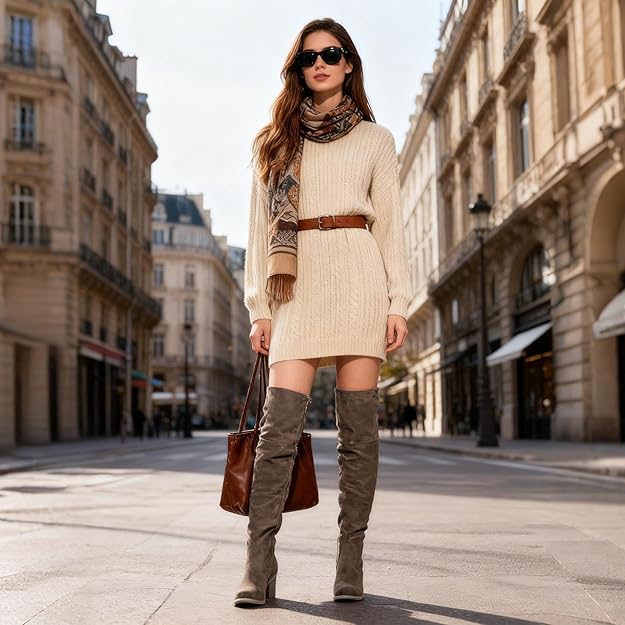
Boots: Complete silhouette
The vertical line and visual weight that completes the outfit.
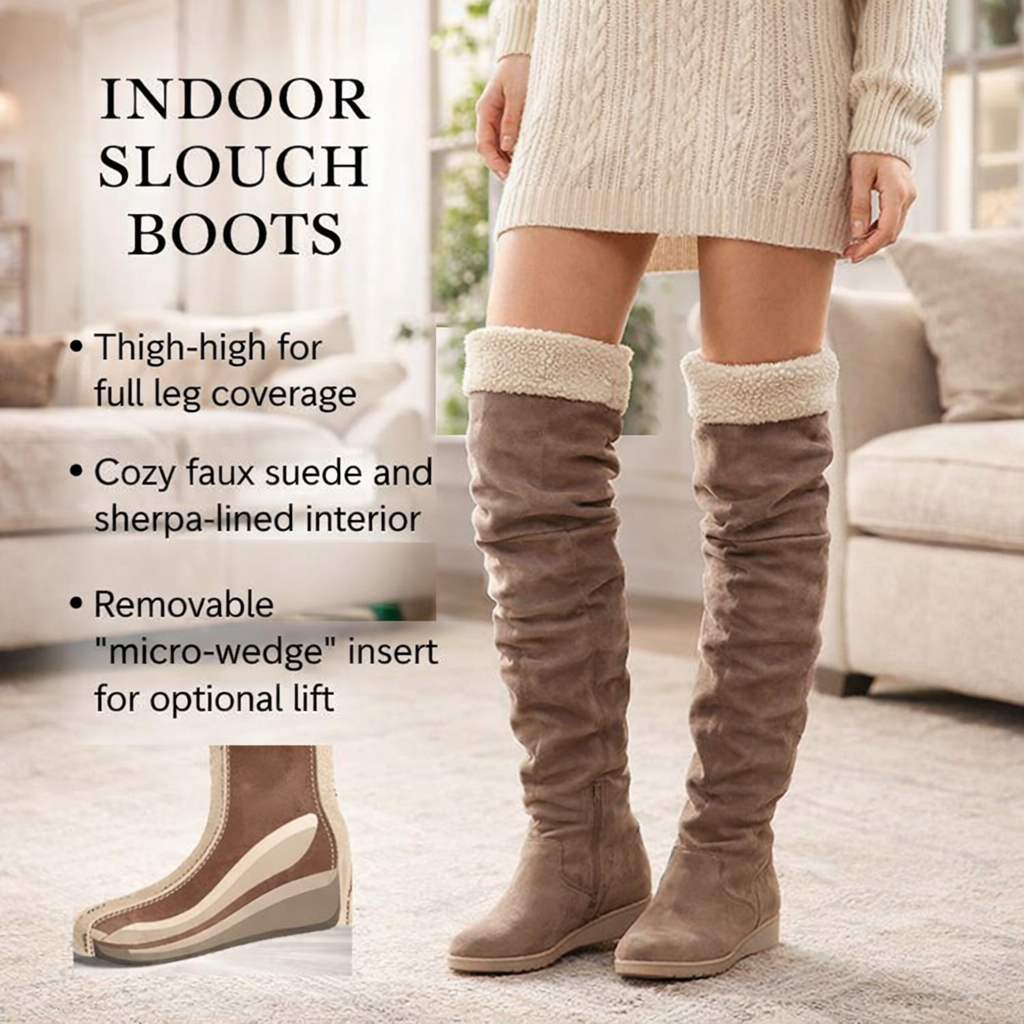
Indoor Slouch Boots: Still complete silhouette
The outfit no longer loses its anchor when shoes come off indoors.
Customer Value
Preserve the outfit
Maintain the boot-driven silhouette indoors (vertical line, grounding, proportion).
Preserve posture and presence
Optional micro-lift reproduces subtle postural benefits of heels without a visible heel.
Respect no-shoes etiquette
Indoor outsole: clean, quiet traction, non-marking, comfort-first.
Reduce "compromise decisions"
Fewer moments of changing outfits because "it won't work indoors."
Initial Product Direction
The goal is not a novelty slipper. It's a minimal, intentional "house boot" that preserves the leg line and the sense of being dressed—indoors.
Two silhouettes
- Knee-high: everyday indoor wear, hosting, WFH; slouch starts mid-shin.
- Thigh-high: statement indoor silhouette; extended slouch with optional fold-over styling at the top.
Design principles
- Slouchy, unstructured shaft (soft "collapse," not rigid structure).
- Boot-like foot shape (reads "finished," not sock-like).
- Minimal exterior (avoid tassels, heavy trims, visible "slipper cues").
- Quiet indoor movement (traction without stomp).
Materials (more specific recommendations)
- Upper: faux suede with knit backing (for slouch without permanent creasing), brushed knit, or felted textile with light stretch.
- Lining: fleece or sherpa variants for colder climates; lighter brushed lining variants for warmer interiors.
- Footbed: EVA or memory foam base with fabric sockliner; designed to accept an optional micro-wedge insert.
Grip (indoor traction options)
- Thin non-marking rubber outsole (quiet tread pattern).
- Silicone/rubber dot grip integrated into fabric-like sole (ultra-quiet).
- Suede-like bottom for soft traction (region and surface dependent).
Staying up without being constrictive
- Light elastic or ribbed knit zone near the top (stretch over compression).
- Fold-over top option to distribute weight and reduce slipping.
- Strategic seam placement for "soft structure" without stiffeners.
The Micro-Wedge Insight
Heels have two roles: a visible symbol and a physical effect. The physical effect (posture, stance, silhouette) can be delivered without a visible heel. A small, removable micro-wedge insert can provide a subtle lift indoors while keeping the product house-appropriate.
Low-complexity implementation
- Slip-in wedge under the sockliner (preferred; no Velcro, minimal parts).
- Footbed recess/pocket that captures the wedge via friction fit.
- Offer as included, optional accessory, or omit for entry SKUs.
Note: the wedge is intentionally "micro"—enough to be felt, not enough to become uncomfortable or visually obvious.
Market Validation (Lightweight, Honest)
This concept originated from observation rather than formal research. In no-shoes homes, the "outfit drop" when boots come off is common and normalized, which makes it easy to miss: it rarely triggers complaints, and instead shows up as quiet behavior changes.
Early validation methods (low overhead) could include short intercept surveys ("Do you avoid outfits indoors because shoes come off?"), retail associate feedback from footwear/loungewear stores, and social listening around leg warmers, slipper socks, and "house shoes."
Market Size (Directional)
This category sits at the intersection of indoor footwear/slippers, casual boots, and comfort fashion. Slipper markets are large and recurring, and no-shoes cultural norms are widespread globally (including common adoption in urban North America). WFH and hosting culture increase time spent indoors while dressed intentionally.
For manufacturers, this is best viewed as a low-risk category extension: an adjacent product that formalizes an existing workaround behavior.
Existing Alternatives (Clarifying Differentiation)
Outdoor boots worn indoors
Break indoor etiquette; louder/heavier soles; not designed for indoor-only comfort or traction.
UGG-style boots / cozy boots
Closer, but still typically outdoor-capable construction; less focused on silent traction and "indoor-first" design intent.
Chunky slippers
Comfort-forward, but generally stop at ankle/mid-calf and don't preserve the leg line that completes many outfits.
Slipper socks / leg warmers
Warm and partial silhouette help, but don't anchor the foot or read as finished footwear.
Washability & Shape Retention
Washability is a design constraint, not an afterthought. Shape retention can be achieved via "soft structure": strategic seam placement, light ribbing zones, and avoiding heavy bonded layers that permanently crease.
- Materials should tolerate gentle machine wash or hand wash; air dry recommended.
- Prefer knit-backed faux suede or felted textiles that recover shape.
- Consider removable insoles (and wedge inserts) to improve wash/dry performance.
Questions for Manufacturers
- What materials best achieve slouch without uncontrolled collapse?
- How can we retain shape and comfort after repeated washing?
- What is the simplest, most durable implementation for a removable micro-wedge?
- Which existing manufacturing lines could adapt to this with minimal retooling?
- What outsole approach best balances quiet traction and durability across common indoor surfaces?
Status
This page is a public concept note—shared for discussion and posterity. It is not a product launch or solicitation. If this observation helps a team already operating in indoor/outdoor comfort space prioritize an unexplored category boundary, that is the intended outcome.